
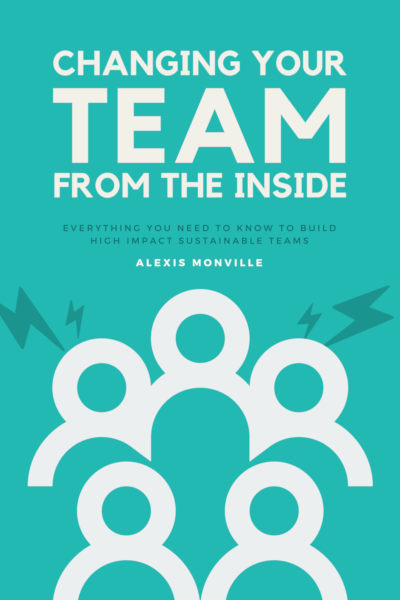
Alexis Monville from the Red Hat Engineering Leadership team joins me to talk about his experiences leading, developing and changing teams. He’s also the author of a new book: Changing Your Team From The Inside.
Podcast: Download
Subscribe: Apple Podcasts | Android
Conversation Highlights
- Alexis helps engineering teams at Red Hat be more efficient in systematic ways
- Alexis’ passion for open source software development and how it ties into his work
- Team members often know something needs to change, but they rarely think it’s them that needs to change
- Teams are often really good at “resisting” so being told to change by an outside party rarely works
- Using “visioning” in retrospectives
- Positive ways to turn retrospective discussions into real change
- The importance of assigning specific owners to a new team processes or responsibilities
- The value of checklists
- How to engage people in games or activities they don’t want to participate in
- The importance of believing in what you are doing as a leader
- The tension between what people want and what they think is possible
- How large a team can be and still effectively change
- The percentage of times large scale change works vs. fails
- Every member of the team is responsible for changing things
- Asking “how?” instead of “why?” leads to more progress
- Addressing the “dysfunctions of teams” in remote (geographically disbursed) contexts
- Helping people come together as a team vs. a “group of individuals”
- Getting personal with each other
- The value of empathy
- Success using empathy maps
- Helps to create a three dimensional avatar or persona
- A very constructive way to draw out disparity across a team’s perspectives
- Waterfall software development
- Our natural inclination to think in terms that are too black and white (polarization)
- Ego is the Enemy by Ryan Holiday and how it relates to changing teams from the inside
- Creating better self-awareness for ourselves
- Not getting in the way of our own progress
- Self-awareness is a very key aspect to initiating change
- Start enacting change now with small experiments
- Alexis’ parting challenge
- Pick one thing
- Start and do something now to invest in yourself or your team
Suggested Books
- The Goal: A Process of Ongoing Improvement by Eliyahu M. Goldratt
- The Five Dysfunctions of a Team: A Leadership Fable by Patrick Lencioni
- Search Inside Yourself: The Unexpected Path to Achieving Success, Happiness (and World Peace) by Chade-Meng Tan
- Changing Your Team From The Inside by Alexis Monville
Contact Alexis Monville
- Linkedin: Alexis Monville
- Twitter: @alexismonville
Related Episodes
- Building and Leading Effective Remote Teams (78) — Alexis, Michael Doyle and I on remote teams
- Giving Feedback and Taking Responsibility (93) — Alexis and I on giving feedback
- Exploring the Ego with Michael Doyle (73) — Michael Doyle and I on Ego is the Enemy
- The Power of a Heart at Peace (96) — another conversation with Alexis Monville
Credits
All songs licensed under Creative Commons
Transcript
This transcript was created automatically and may contain small errors.
John: Alright, today I’m talking to Alexis Monville, who has a new book out called Changing Your Team from the Inside: Everything You Need to Know to Build High-Impact Sustainable Teams. Alexis, welcome to the podcast.
Alexis: Oh, thank you, Jim.
John: So Alexis and I met about a year ago. We worked together very briefly, never in person, although I have, I think, met you in person. Maybe I haven’t. I don’t know. Anyway, we worked together about a year ago briefly. I’ve kind of followed your work since then. I saw on LinkedIn that you had this book coming out and I said, oh, can I read the book? Can we talk about it? You said yes, which is excellent. So tell us a little bit more about what you do at Red Hat and how you got into this particular line of work.
Alexis: Well, this is a really great question and it Could take me a long time to answer that question. I will try to keep it short. So I’m working in the engineering leadership team at Red Hat. My main focus is working on organization and management, helping teams to be more efficient and in a sustainable way. That’s my main area of work. And I come to that starting as an engineer in mechanical engineering. And being passionate with computers, make the link between the two. And starting companies, growing companies, working with large companies, small companies, doing consulting, working with the government, and became passionate about open source. And then working with Red Hat because Red Hat acquired one of the companies I was working with.
John: And what is it that you’re passionate about open source?
Alexis: The main thing was all those people that are living 1,000 miles away from each other and that are able to create great things that are really solving their problems. And I was really passionate about that because, yep, that’s probably an interesting way to organize people because, yep, some people find their way to organize themselves to create something great. So, looking at how they are working. And in fact, there’s really many different ways to work when you speak about open source projects, but that was the main interest.
John: And open source, for anyone that is not in the know in terms of software, open source software is this idea of open development where everyone sees the source code, everyone can contribute. That’s how I would put it in layman’s terms. Would you add anything there?
Alexis: Yeah, I think you, you, you, you have it. That’s, you, you are creating something for the common good. So anybody can use it, change it, contribute to it, and distribute it. So that, yeah, this is really it.
John: Are there any parts of open source that you find that are not so satisfying or attractive?
Alexis: Yeah, I think there’s those kinds of downsides that I will say are not are not necessarily linked directly to open source. I think it’s mainly people behaviors.
John: So people are the common denominator.
Alexis: Yeah, that’s mainly that. Oh yeah, you see that way of behaving on a mailing list or a way of behaving in your review comments on the code that you are reviewing. And that is maybe not really considerate for the other person and not as respectful as you would like that to be and so on. So that’s really behaviors of people. But that’s not necessarily linked to open source. It’s really behavior of people. And it’s visible in the software world because we are using electronic tools to communicate really.
John: So, what was your motivation for writing this book?
Alexis: It came from the idea that, to be honest, at the beginning, I thought that, a few years back, I thought that was really a book about organization that was targeting managers or targeting leaders that wanted to change things. And I started something around that, on open source and agile, and something around that. And it didn’t work really well. So I changed the angle and said, yeah, you need to appoint someone to foster the change in your organization. You need a transformation manager. And I started that with that angle, and I realized that, no, it will not work because even if you are doing that, it’s not necessarily working. And we can see that all the change management efforts are unfortunately failing, not all of them. 70% of them, according to the different studies I’ve read. So yeah, it’s really a problem because you know that you need to change, and unfortunately, you’re not able to do it. And I realized that there was a lot of people in their teams that had that feeling of, we really need to change something. Can someone do something about it? And they were helpless waiting for others to do something. It could be the managers, it could be the head of the company, it could be other team members. And yeah, there was something wrong about that. If we are all waiting for someone else to change, it will never work. So I thought, yeah, I need to write something down about what you can do when you are a team member and what you can do to change the situation in which you are. So that was the main idea of the book.
John: So would change from the outside, would that be the more traditional change management or reorganization, or what would exactly that be? What’s the opposite, I guess, of your approach?
Alexis: Yeah, that’s exactly— you are telling people how they need to change, and you are telling them when. And it’s not really working because the first thing they will do is resist, because we are really good at resisting, either actively or passively. Because when we are told to do something and we don’t understand why, we don’t necessarily want to do it, we are good at staying exactly the same.
John: I like the section in— you talked about— you had a section in here around visioning, which was this idea of imagining I don’t know if I’ll use the word perfect, but I think of it, at least in my coaching work, I often have people kind of examine— or examine— I’ll have people imagine a perfect future. And then we will work backwards to create that versus let’s just iterate on what we have. So, I guess what I wondered there is, there’s a section later on in the book around retrospectives. Have you ever brought visioning into retrospectives? And if so, how did it work?
Alexis: Yeah, this is interesting. The thing is, when you are working on the retrospective, you are looking at the past, you are looking in the mirror, and you are looking at what was done. So, there’s not really vision in that part, because at some point, when you are able to work with the different team members, you get to a shared understanding of what happened. So, that’s not a vision, that’s what really happened. But next, you are doing your retrospective to do something for the future. And sometimes it’s really useful to say, okay, what is that future that we already want? And doing the visioning exercise at that stage is interesting because, yep, you are saying, okay, in 2 years, that’s What will be? And then you can go backward to say, okay, what needs to happen to make that vision a reality? So I think that could be something that you can use in a retrospective, not necessarily in the retrospective that you are doing every week or every 2 weeks with your team, but when you are doing something that is more longer term, and when you want to really change something that will impact the future. 6 months from now or more than that.
John: Ah, that’s a great distinction. And so, by the way, so again, people not in the software business, a retrospective is often used in agile software development where at the end of a given iteration or sprint, the team takes stock of typically what went well, what didn’t go well, what we might want to keep doing, what we might want to stop doing. And then you take that information to make the next iteration better than the last one. But, and I left, I love this part. You wrote, regardless, I’m not sure if you were quoting from someone else or, but it was kind of the tone of the retrospective, which I haven’t always seen. And I thought was a great way, would be a great way to set up a retrospective. And you wrote, quote, regardless of what we discover, we understand and truly believe that everyone did the best job they could, given what they knew at the time, their skills and abilities, the resources available, and the situation at hand. What I love about that is kind of assuming good intent or assuming that everyone was doing the best they could.
Alexis: Yeah, it’s a quote from someone else, and it’s called the Prime Directive. And I think that it’s really important to have that, yeah, to foster that mindset if you want to do something about a situation. And that’s it. If you want to go over the unfortunately classic blame game that you can see in some situations where people are only good at blaming each other about something and you are making no progress at all.
John: What have you done in situations with retrospectives where there’s lots of excitement about maybe rehashing the past and other people’s failings and then talking about, yeah, this is what we’re going to do differently. But then actually implementing those improvements, I have seen that fall down more times than I’ve seen it succeed. Is there a particular technique that you have that actually makes it work?
Alexis: Yeah, really, really good point. And that’s the part that can be frustrating with retrospective. And I’ve seen that with some teams when you organize a retrospective. As you’ve said, there’s a lot of energy about what we should do to change, and even what we will do to be able to change the way we are working. And then, when we start to work again, we are working. We are not working on how to change how we work. And then the next retrospective comes, and yes, we could just say, oh, that was the action from the last retrospective.
John: Yes.
Alexis: And unfortunately, we did nothing. So maybe we can do all the same actions, or maybe we can just forget about it. And that’s really frustrating. And the reason is we have a tendency to classify those actions as secondary compared to the real work that we are doing. And if we are doing that, we will never do that. So I think all those actions that are meant to improve the way you are working needs to be put in your work. That needs to be actions that will be handled by people in the team. And that’s their responsibility to deliver on that. And that’s now part of their work to do that. And it’s really important that improvement actions are already part of their work and tracked as so.
John: Can you give an example of that?
Alexis: Yeah, let’s say, We look at the way the team is working, and we realize that there’s a lack of synchronization between people. And at some point in the retrospective, we decide that, okay, we need a daily synchronization with the people. And we say, oh yeah, we will now meet every day for a short synchronization so we are sure we are all on the right track. Okay, that’s a good action. If nobody in the team is there to implement it, the next day there will be no meeting.
John: Hmm.
Alexis: And the next day there will be no meeting, and the next day there will be, and so on. If you say, okay, that’s a good action, and we want really, we are committed to do it, and please, one team member will be in charge to make it happen. Schedule the meeting, to call everybody, to be sure that everybody’s on time and to understand why they are not, and so on and so on. He will have that responsibility. He or she will have that responsibility to make it happen. So it’s a simple one, but if you are not putting someone in charge of having it, people can forget about it.
John: You just solved years of frustration for me right there. I can’t tell you how many. Yeah, I At a certain point as a program manager, I pretty much gave up on retrospectives because I never, I never saw them work. And I’m seeing now that, yes, if I— oh, that would have been one of those pointy program manager questions too. As you’re going, I can totally see this now, as you’re going through the process and someone says, yeah, we really need to have this standup. The next question would be, and who will be the owner of that process? And I can just see as a team saying, well, if we don’t have an owner that’s going to own this, then we’re not going to sign up for it. Versus all these— yeah, my retrospectives were so aspirational and little to nothing came from them.
Alexis: Another way that I found really effective was to have checklists. That sounds weird. You say, okay, we all are grownups, we all know how to work, and we don’t need a reminder about all the things we need to do. And in fact, I found that really useful to say, okay, that’s the checklist for a meeting. That’s the checklist for that weekly meeting that you have. And you have a checklist, everybody knows that there’s a checklist, everybody can see the checklist, and we are going through the checklist. So when we say, okay, at the beginning of the meeting, to be able to remind why we are working, in fact, we have a checklist, and the first item on the checklist is review our goals. And so, we will display our goals and we will review the goals. And we have 1 or 2 or maybe 3 objectives, and we have the results that are for each objective that are helping us to stay on track, and we’ll review that. And it focuses the attention on what we are trying to achieve. This is really good, review the goals. But if you don’t have a checklist, you will not do it because there’s always an urgent issue that everybody wants to discuss. And then you start the discussion and you forget about it and it’s gone. Or review the action from the previous meetings or things like that.
John: Right, right.
Alexis: If you have a checklist, it’s working.
John: Yeah. And also the owner too, because, yeah, because what would happen was we would say, okay, we’re going to do this one thing. And then I would start to push for it at each subsequent meeting. And then over time, it would fall off the list or people would just really resist it or they would just wouldn’t do it or they wouldn’t want to do it. Anyway, yeah, it’s all back to the owner or it being on the list. I love that.
Alexis: Yeah, if it’s on the list, you nearly don’t need an owner because, yeah, it’s the responsibility of the whole team. So if the team decides to put it on the list, it becomes an item on the list and you can call each other on your bad behavior if you are not following the list.
John: Right, right. So we agreed to put it on the list. We’re not doing it. Now, what do we as a team want to do?
Alexis: Yeah.
John: You talk a lot about games and different activities in your book. How do you get past the naysayers and the eye rollers and the people that just, you know, they’re like, you know, we’ve all been to these things, you know, where the facilitator is like, okay, now we’re going to do this activity. And people are like, ugh, what are your secrets for Engaging people and getting people participating as fast as possible.
Alexis: This is really an interesting point because we all think that it’s really difficult to engage people in all that fluffy stuff about— just considering that we are human and we all want to do the real work, the hard stuff, the technical work that we are here to do. And we don’t want to consider us as human beings. I was also in that trouble. I was even not calling those activities games for a long time because I’ve said, oh yeah, we are serious. We don’t want to play games in— I was trying to say it’s serious games or it’s a simulation, and you can call it whatever you want. It’s still games. You are in a safe space for a certain amount of time and you can risk things and you will learn a lot about others. So in fact, it’s a game. The cool thing is when you really believe it will have benefits, when you start saying, okay, we will do that now, people will follow. Even if some of them are not totally convinced, if you choose your game carefully, they will be convinced at the end. Not at the end of the game, they will be convinced at the end of the meeting, for example. Because they will recognize that the level of energy, the positivity that really gets things done is there because of what happened in the meeting. So they will, at the end, be convinced that it was a good investment. And sometimes it takes time, but yeah, it’s working.
John: So a key thing that I hear there is leadership. You as the facilitator really leading and really having confidence that what you’re about to do will work.
Alexis: Yes. That’s— you need to believe in it. Yeah.
John: Because if you just show up and say, well, let’s try this silly exercise that I think might possibly help us. Yeah. Nobody’s going to really want to follow along.
Alexis: Yeah. And sometimes some people really want to know why we are doing this. And the why is really difficult to explain because sometimes you You are doing that game because you want people to discover that some of their behaviors are toxic, for example, or the way they are doing things is not the right way. But you cannot explain why, because if you are saying that, basically you will not have a game, you will not even have a meeting. Because if you can tell people, okay, I think your behavior is toxic, so let’s demonstrate that with a game, that will not really work.
John: Yeah, I can see that.
Alexis: But yeah, you can use those activities to make people realize that, oh, maybe they can approach a conversation in a different way, and it will really work better.
John: Of all the different processes, I’m not sure quite how to phrase this, but so in your book, you talked about different teams, different processes, different companies. What are some of your favorite challenges that you Overcome, overcame, or have overcome and why?
Alexis: There’s several. I think there’s always a tension when people really want to achieve something and then they don’t know how they will do it. And they really want to do it, but in fact, nearly they think that it will not work, it will not be possible. And that happens a lot. A lot of time that you really want to do that, you have that challenge. Now everybody agrees and unfortunately it’s too short or you don’t have enough resources or there’s other things that you don’t have to make it happen. And working with teams in that situation is always interesting because they already want to do something, they just don’t know if it’s possible. Moving from it’s not necessarily possible to, yep, we can do it. And in fact, yes, we are doing it. It’s really fascinating and it’s really energizing because you have that group of people that is able to do something. And yeah, this is really cool.
John: What’s the largest team or organization that you have helped change? Like how many people?
Alexis: I never think about this. And if you think at a large scale, probably Red Hat is already large, and you cannot really work with all the people in the company. And when I was working for the government, you are not working with all the civil servants. You are only working with a few of them, and you hope that working with the small group will influence the larger group and so on. And it’s always like that. So even when you say, oh, I worked with that product team, it’s 300 people, or I worked with engineering within Red Hat, it’s probably thousands of people, you are not working with all of them. So you are only able to influence the people that are near you, and it’s usually a small group of people. It’s not really large.
John: So what’s the upper limit that works effectively in a large-scale change environment of your immediate working group?
Alexis: I think the upper limit is with who you are working. The limit is the influence of the the people in the organization. So if you are working with the corporate leadership team, that’s a small team, that’s a small group of people, that’s maybe 10 people, and you will influence the larger company and you will influence even the partners of the company or the customers of the company and so on. So your influence could be really large because the people you are working with and their position they are really influential. So your upper limit is with who you are working with. If you are working with a small team that is delivering a service or product, that’s a small team of maybe 5 or 9 people, and you will influence that team and probably the other teams that are around that team and so on.
John: What is your— what is the success percentage or success rate that you see in terms of changing teams?
Alexis: It’s, uh, it’s— it depends when, uh, if I’m really, uh, in a good mood or in a bad mood.
John: Yeah, I mean, I can— yeah, I mean, I’ll cut to— I’ll, I’ll out myself here and say that I’m— I have not seen it happen positively. I’ve seen it happen less than I’ve seen it succeed. And so I’m wondering if, given all your experience, you’ve seen something different.
Alexis: The thing is, we are, and I am, probably demanding a lot from myself and others on that. So when we are working on improving something, it’s usually easy to say, oh, we are not yet at my vision. So we are failing.
John: We are not good.
Alexis: The change is not enough. And it’s difficult to recognize that, yeah, we made some progress in that journey. And yep, it’s working. What I would call a failure is when you implement some changes, it seems it’s working. And I’ve seen that when I was working as a consultant, working with companies. And you work with the team for a few, maybe a few weeks, you implement some changes, it’s working, the team is making progress, then you leave. And when you come back a few weeks back to see how it’s working, the team is back to its old behavior. And all the changes that have been implemented implemented are gone. And this is a failure, and it happens from time to time. And I think it’s because people don’t see the value of their new behavior. And sometimes it’s hard to persist when you don’t see why and you don’t see the positive impact of what you are doing.
John: So I hear an important thing in there too, which is celebrate the small wins versus we— yeah, that’s a good challenge back to me. Yeah, so in terms of making it a binary, yes, we’ve succeeded or no, we didn’t, it’s seeing those things. Yeah. What about a situation where there’s not a specific leader? In other words, you mentioned people are not believing that it can change. My next question there was gonna be like, well, whose responsibility is that? Sometimes there’s kind of a change agent that’s assigned to a team, but oftentimes there’s not. It’s just, you know, management just kind of says, hey guys and girls, go fix this.
Alexis: Yeah. And And even if you, if you, okay, you, if you, if you say, oh, okay, there’s a manager here who wants that to change, yeah, maybe you can do it. But even with that support, in a way, it’s not necessarily easy to do it. And let’s say you don’t even have that, you don’t even have that support. Whose responsibility it is? And I think we are much more influential than we think. And that’s where we need to start. In fact, it’s the responsibility of each individual to change things, and you can do it. And it sounds really weird because we say, okay, you can do it. It’s nearly what you will find on t-shirts or things like that.
John: Yeah.
Alexis: But how can I do it? And in fact, looking for how you can change things is much more efficient. So yes, you can do it. And your actions are really influential on other people. And even your mindset is really influential on other people. And sometimes you just need to ask a few questions, not confrontational questions like, why are you doing that? But More, how can we do that? Or even, how can I do that? It’s much more efficient because suddenly when you’re asking how something, people try to find a solution for you. And if they try to find a solution, then you are making progress. We are making progress as a team.
John: Well, borrowing from what you said a little bit earlier, also looking for small things to change, believing that they can lead to bigger things versus saying, well, I can’t fix this whole big thing, so why bother?
Alexis: Yeah, absolutely.
John: So, you mentioned Patrick Lencioni’s 5 Dysfunctions of a Team, and if you’re not familiar with that book, here they are real quick: absence of trust, fear of conflict, lack of commitment, avoidance of accountability, inattention to results. As I thought about these, I wondered what unique approaches or techniques you’ve taken with remote teams. So, you told some stories in the book about teams working together in person, having meetings, breaking through some of these things. But what would you say to a team that’s geographically dispersed, they’re not able to meet in person regularly, and they have one or more of these dysfunctions that’s really holding them back?
Alexis: Yeah, it’s really difficult and challenging. And I worked with a lot of geographically dispersed teams. The first thing I would say is get to know each other and to be able to get to know each other, you need probably to meet in person. So it’s a little bit contradictory to, yeah, yeah, you want to team of people that are all over the globe, and the first thing you need to do is get together. But if you can’t do that, okay, then you need to admit that you will have to find ways to get to know each other. And remotely, it’s quite hard. And there’s a lot of different things that you can do to start to get to know each other. And I’ve seen things that Yeah, you are bringing things for a show and tell, for example. Oh yeah, small exercise. Yep, next meeting, let’s work on that. And for the first minutes of the meeting, we will have a roundtable and we will have a show and tell. So bring an object, bring something that you want to show to the others in the team and explain why you choose that object. That could be glasses. I’ve seen someone bring glasses, sunglasses, and I was looking at that to say, okay, sunglasses, what’s that? And in fact, it was really specific sunglasses because it was sunglasses that that person was using to pilot a plane. And suddenly it becomes really more interesting because, yeah, that was not all those sunglasses. And in fact, the sunglasses Nothing interesting, but being a pilot, becoming a pilot, that was really interesting. So the show and tell could be the first thing and making progress on that. There’s also teams that are making progress because they are doing things with each other. That’s what we call pair programming, for example. It’s easier to be done when you are in the same room, but now with the technology that we have, you can share your screen and you can work with each other to do something. And if you are not in the software development business, try to write a difficult letter or a difficult text using a shared document and having the audio on and working with each other to try to craft a good document. And it’s really powerful. And when you work with each other, you get to know better and you get to understand better why do people are using those kind of words or the approach they have and so on. And you build what is really important for a team. You get to know each other, you start caring a little bit more about each other, and you are building trust. So even if you are not in person, you can have those kinds of activities that will help the team becoming a team, not a group of individuals working on their own.
John: Well, and it sounds like a key aspect to that is getting really personal. So, I am a pilot, or I’m learning to be a pilot, and here’s what’s involved.
Alexis: Yep. And it can be a lot of different things. It could be because you care about your family, or you care about the community you are involved in, you care about the environment, you care, you start to share more than what makes you a whole human. And it’s not only your role in the team or your function at the company or things like that. It’s a little bit more. And people are not necessarily comfortable with that because it makes them vulnerable. You need to admit that you are failing at something. I’ve seen a team member explaining that he had real difficulties with one of his teenage children, and it was really painful to hear. And he was a manager, and you are expecting a manager to be really great at doing things and leading teams and organizing everything and working with people. And when you are failing with your kid, you don’t necessarily want to share that. But it was really interesting to hear from that because it explained a few things about his behavior. And in a way, he found some support in the team to help working with his teenager. Because one of the other team members said, oh yeah, by the way, I have a kid the same age who is really passionate about It was bike riding and so on. Oh, maybe we can meet and maybe they— let’s see what they are doing with each other. And those guys really helped each other and they became both really passionate about biking. So that was really cool.
John: Wow.
Alexis: That solved a lot of issues. So I’m not saying that you will find help on everything within your teams. But being more vulnerable will help the other understand how you— what you are going through. And sometimes they will be able to help you even.
John: Yeah, that’s beautiful. It reminds me of something I’ve often encouraged people to do, which is to look for excuses to have real-time conversations with people. So in today’s online virtual work world, where you can just chat at someone on Slack or IRC or whatever you’re using these days, I will often encourage people, instead of just simply asking that question in the chat, have a video call, have a phone call. Like, in other words, yes, you could get your answer that way. But taking a small opening, like, I need an answer to this problem, to have a real conversation can also be a way of starting to get to know other people in a remote environment.
Alexis: Yeah, yeah, absolutely. And You will interrupt them. And that’s usually the good excuse that we have to not do that.
John: Yes.
Alexis: Not ask, not go to see someone. Oh yeah, I will interrupt that person. Yes, this is true. And if you’re already worried about that, maybe you need to define team agreements that makes the interruption period, define the interruption period. Yep, I don’t want to be interrupted during that period. But yes, you can ping me during that period and the team can decide that. And then it becomes easier because, you know, yep, we can chat about this and it’s okay.
John: You were mentioning empathy there as well, like this interaction between these 2 people, they now had more empathy for each other. In your book, you have the empathy map where it’s the person’s head. Yeah, what’s called empathy map. Have you used that a lot? I had seen that in a, I think it was Game Storming by Dave Gray, and I used it once and it sort of worked, sort of didn’t with the team I was doing it with. Have you seen success with that?
Alexis: Yes, it’s always interesting to use it because it helps people to share what they all know. And unfortunately, they don’t know the same thing. That’s why it’s really successful. And I worked with one team that they were always referring to the users of the product.
John: Those users.
Alexis: And it was always interesting, but I was unable to understand who were the users of the product. I thought I was smart enough to understand that. Each time they were referring to the users and why they were doing what they were, what they wanted to build some features and so on in their product, I was not able to figure out who were those users. And we used the empathy map to try to understand who were the users. And they didn’t want to do that at the beginning. And they started to work on that. And at some point they said, okay, but we are not talking about the same person. And suddenly, we had two kinds of users. And then, oh, but we had another person that was another stakeholder that was really important in the process and in the decision process, and who was caring about other features. And suddenly, they understood that yet that group of product managers were managing a big product, but they were targeting different kinds of people, and we had uncovered the need to define different personas. And there will be features that will target some of those different personas. And it was really powerful.
John: Yeah, I remember the first time— in fact, I think I saw— so, Dave Gray, who is part of a company called Explain, they have an office, I think headquarters here in Portland, Oregon. I was at a free event they do monthly. And I remember the first time I saw this, it blew my mind. So, the empathy map, for people that aren’t familiar with it, It’s the picture of a head. And so you have the eyes, the mouth, the ears, the head, and, and the, the, the questions that this— that you’re trying to answer for each aspect of this picture is, what does this person— so if it’s a user, what do they see? What do they hear? What are they thinking? Uh, what are they experiencing? What are some of the other ones?
Alexis: Yeah, what are they saying about your product?
John: Yes, yeah.
Alexis: What are they hearing? That could be from you or from others. How do they think? How are they doing things? What do they think? And then suddenly, yeah, yes, you need to think about it because what do they say apart from nothing? You need to work a little bit in the team and suddenly There’s people that are saying things that are interesting.
John: Well, and it gives you almost like a 3-dimensional avatar. There’s this kind of the, you know, you have to create these avatars of Sally and Harry and this is what they do and this is who they are and this is what they like. But yeah, there was a 3-dimensional aspect that came out of doing this that just like completely blew me away. I was like, wow, this is a completely different way to figure out what people really need and what they want.
Alexis: you also will be able to uncover that you don’t know.
John: Yeah. So you’re making a lot of assumptions.
Alexis: Yeah. And suddenly you realize that, okay, as a team, in fact, we don’t really know. So we need to, we need to work on that. And we need to go to see real people to understand how they, how they are experiencing things. People that are working on user experience and so on know that perfectly well. But it’s not enough. You need other people to really feel that, understand that, and experience the real experience of users if you are building a product, or other people if you are building something else or working on something else.
John: So, watching you from afar at Red Hat and everything I’ve ever seen and read about you, your work has been in agile software development. Do you ever do anything that’s— and so I’ll just— my question is, do you do anything in the waterfall space or in waterfall development, and do you see a place for that? And so for people that are like, John, what are you talking about? What’s waterfall? So I explained iterative development before, which is short iterations, 2 weeks, 3 weeks, a month, and then you release something. As opposed to waterfall, which is more traditional software development where you might have a very long planning phase, and then you would start developing, and then once developing is done, then you do testing. So it’s very gated. You don’t start one activity until the previous activity has ended. Is there a place for waterfall, and do you do any waterfall software development help with people?
Alexis: Yeah, this is a really good question, and we are back to the sort of binary way of seeing the world.
John: I think that’s a weakness of mine.
Alexis: No, really, we are all in a way doing that every time when we try to label things and we tend to try to describe things as black and white because it’s easier. It’s either black or white, but we know that it’s not working. When you are looking at all the white paintings to try to paint your walls in white, and you try to choose the paintings, you can see that there’s already 15 different whites, and now you need to choose. And I’m not— I’m just talking about the white, but if you are looking at all the colors, there will be an infinite amount of choices. And everything is this way. It’s not waterfall and/or agile. Or something, and you can have frameworks that are way to describe way of working, and you will need to implement that framework and to adopt that and to adapt that in your context, and you need to accept that it will evolve. And in fact, I worked with companies that were saying that they are they have a really well-established waterfall model, but they were not using waterfall, but really. a well-established process that was going from the inception of an idea, and then you have a milestone and so on, and then at the end you had a successful product. And all that was exactly a well-defined waterfall model. But when you were looking at how people were working, they were unable to work in those phases. Because, of course, they were working in the inception of the product, the inception of the ideas, and then they had that milestone, they had the validation to go in the next phase. And in the next phase, they were uncovering that they were wrong on some of their assumptions in the previous phase. So they were modifying things discreetly without telling anybody, and they were changing it for the next phase and so on. In fact, they were not respecting their own process because they were changing things, they were adjusting things. Unfortunately, when they were working with other teams in charge of one specific phase, that’s where the troubles were really coming because suddenly when you need to change something, if you need to go back to the start of the process, it can take a long time. And the thing is, you If it’s different teams managed by different people, you tend also to blame the people that prepare the work before you take over. And so waterfall can lead to have more handover and divisive behavior in the organization. But it’s not only, yeah, it’s usually not Followed as it’s defined. So it’s usually already adapted and sometimes not so well and not so— it’s not really shared.
John: Would you say there are products where a more pure waterfall process makes sense?
Alexis: I don’t think it makes sense. It’s really difficult. To have activities that are really isolated from each other. And it’s difficult to plan everything upfront and to have no changes to be made afterward. So I think it’s really better to try to say, okay, yes, we Let’s say we want to build that product. We want to build that car. To build that car, we need probably to design the car at some point. And so, yes, you need to fix some aspects of your development upfront. You want to build a car that will have 1, 2, 3, 4 seats and so on. You want to build a car that is able to reach certain speed, certain autonomy, certain— you need to fix some of the constraints upfront, and that will probably not change because if you know that you are changing that, that will impact all the rest. So you need to define certain things, and those things will probably not change, or maybe they will, but then you will know that it will affect other aspects. But you cannot define that for 18 months of work all the aspects of the work. So you need to do that iteratively. You need to say, okay, that’s our first goal is to have that by— during that period of time. And if the constraint is the time, then you need to discuss what can be done during that period of time. And you are working that with the team. You are working that with the people that are in charge of doing the work. That cannot be done outside of that. So you want to have that ability to adjust your plan regularly and to reflect on what you are doing because it’s not only the capacity to adapt, it’s also the capacity to manage risk. When you have a big planning upfront, you— it’s really difficult to handle the risk because you are not able to adjust to what will happen. And you tend to think that if you are not respecting the plan, that you are failing. And people tend to react by explaining that everything is green, until it’s too late to hide the disaster. So the adaptability to, the capacity to adapt, to adjust your behavior will help you to manage the risk. And I don’t think there’s the waterfall development really exists. We are not really doing it the way we are saying we are doing it.
John: You mentioned Ryan Holiday’s book, Ego, is the enemy. How does that, how does the ego and how did your reading of that book influence your perspective on creating change from the inside?
Alexis: We said that’s probably exactly the, when I’m saying that waterfall development, for example, does not exist, or the approach to manage project does not really exist. I will hurt people that think it is, that think it exists, that are people that are certified with some methodology and that are respected for their work as project management, project managers, and handling the work on a waterfall basis. And if they are doing the same about what I’m doing, I will probably be hurt on that. If I can recognize my feelings about that and work on that, I will probably have better answers and a better discussion with them because I will not feel attacked by what they are saying. And I will say, okay, why is he saying that? Why for him it seems not to work at all? Why so? And I will be able to ask questions, not why questions that are really confrontational, why are you saying that, but questions to inquire on to try to understand what people are saying. But your own ego is your own enemy because yep, you are in the way of your own progress if you are not able to recognize that, yeah, you can differentiate what you are doing from who you are. what defines you as a person.
John: That’s beautiful. So self-awareness is really a very key aspect of initiating change.
Alexis: Yes, we know that. And we, we can see those nice quotes about being the change you want to see in the world. And, but yeah, it’s difficult to do. And And at the same time, it’s really easy because you can experiment starting now and you will see the impact. You need to choose carefully what is your next experimentation, but you can see that your own mindset will affect people and you know that. So yeah.
John: Yeah, I love that you mentioned that book. I recently finished reading it myself and it was It was very good, very thought-provoking. You mentioned a number of— I think I lost count of the number of books that you reference in your book and that influence your thinking and your work. If you were to recommend the top 2 or 3 to people to read, what would they be?
Alexis: Oh, it’s really hard. It’s really hard because it depends on what you want to achieve, but there’s a few A few books that can help you on your on your journey, and the things that that really help. I think the the novel are really helping. Something like The Goal from I don’t remember the name, but the the book The Goal is is interesting because it’s a novel, and you can see the person. who is having trouble in his factory and who will find help from other people and that will progress on his journey to transform things. And it’s really interesting because you can picture yourself in the same situation or you can identify yourself and then you can transpose that to your world. So I really love novels like The Goal. You mentioned before The Five Dysfunctions of a Team. Those kind of books are really useful for that. There’s one book that I like also that helps you find yourself a little bit more is Search Inside Yourself. It’s a really interesting book. And there’s one thing that is said in the book that is a really simple experiment that you can make. And the author said that what he is doing when he met someone, when he crossed someone in the street or in the corridor, when he first interacts with someone, the first thing he says to himself is, I want that person to be happy. And it’s really interesting and really powerful to do that. And you can experiment that without saying that to anybody. And you’re just doing it for one day or for one week, and you will see the impact. So those kinds of small things are interesting. And there’s a lot more in that Search Inside Yourself.
John: I love— no, you know, it’s funny. I bought that book a few years ago. I’ve never read it. Now it’s moving higher up on my list. Maybe we should discuss it. But I love that idea. I love that idea of approaching people from the From just an inside mindset of, how could I make this person happy? Like, I’m thinking after we’re done talking here, I’m going to a doctor’s appointment. Yeah, what would it look like just to walk up to the person that you check in with and just think, how could I make this person happy? It changes everything.
Alexis: Yeah. And when you say to yourself, you say, I want that person to be happy, or you can say, Alexis wants that person to be happy. And it will have an impact on you. Yes. And it’s visible from the outside.
John: Yes. Yeah.
Alexis: It’s crazy. It’s really working.
John: Well, no, and I can hear someone saying, yes, John, but you cannot make someone happy. No, I can’t. But it’s a mindset thing and it’s a— I don’t know, it’s an energy thing. It’s how am I approaching someone else? Yeah, definitely. I love that. What is the biggest— well, not biggest, but what are some things that you hope that people will do after reading your book? It’s easy to read a book and have lots of great ideas and be inspired, but what are things that you really hope people do as a result of reading this?
Alexis: Apart from sending me their reviews and giving me insights to improve the book, I would like them to be energized and to try to do one thing, to try to do one small change and to see what happens. And if they are able to start with one thing, I hope that will help them to go to the next thing and so on. So that would be really this. That’s It would be to start doing something.
John: My last question was going to be if you had a challenge for people, that sounds like the challenge. Is there anything you would want to add to that?
Alexis: I want them to be happy. Um, and that’s, that’s, that’s really something important. And I would like them to approach other people with that same mindset. And, uh, the challenge will be really this. Yes. Start. Do something now. and invest in yourself. And even if it’s only 15 minutes a day, it’s already absolutely great because that’s— you are moving, you are changing, you are doing something. And you probably already have 15 minutes in your day that you can use to invest on that change.
John: I love it, which is totally different than sitting and saying, well, this is Not going to change and it can’t change until someone else does something. Because the only person we have control over is ourselves.
Alexis: Yes, absolutely.
John: Very nice. Well, any other closing thoughts?
Alexis: Oh, no, apart from that was really nice talking with you and I hope that will help people to do something. And yeah. Please send me reviews about, about the book if you are reading it. I would be really happy to hear from you and to be able to improve it for the next version of it.
John: So where can people go to learn more about you and your work?
Alexis: The main point would be the website. It’s alexis.montville.com. So it’s a simple one and you will find a lot more resources here. Thank you. Thank you for chatting today with me, John. That was absolutely great.
John: Yes, yes, yes. And I’ll also link to those things and any other things I discover and find after our conversation as well. So thank you.
Alexis: Thank you very much, John.
John: Thanks for listening to The John Poelstra Show. Notes, links, and all that other good stuff for this episode are at johnpoelstra.com/podcast. Send your questions, ideas, or a simple hello to REDACTED. Want to stay up to date on new episodes and receive notifications of upcoming events? Register your email address at johnpoelstra.com/listen.

5 Pingbacks