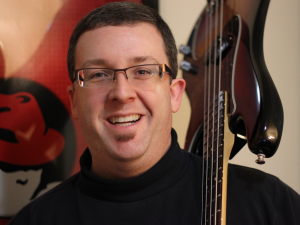
In this wide-ranging conversation, John and guest Paul Frields, talk about working at Red Hat, how they got started with collaborative meeting minutes and Paul’s love of playing the bass.
Podcast: Download
Subscribe: Apple Podcasts | Android
Conversation Highlights
- How we started using shared meeting minutes (first Gobby, then Etherpad) in the Fedora Project and at Red Hat
- Paul’s role on Red Hat Enterprise Linux (RHEL) 7 and his most rewarding moments
- Turning customer needs into requirements and better lifecycle management
- Paul’s path from a political science degree to Red Hat
- Working remotely without becoming reactive: “if you’re always on call for everyone, you’re never on call for yourself”
- How Paul found a vibrant local music scene, open mics and bands as a bass player
- Why drums, bass and guitar are like a three-legged table
- Using a RACI model so one person is accountable
- Quoting people accurately in public minutes so there are no surprises
Here’s Paul with one of his bands…
 
Related Episodes
- How to Succeed as a Remote Worker (19) — Paul back to talk about succeeding as a remote worker
- How to Create and Publish Your Own Podcast (22) — Paul and I on creating your own podcast
- Collaborative Meeting Minutes–Listener Questions and Feedback (12) — listener questions about collaborative minutes
Credits
- Pulse Rock by Kevin MacLeod
- Sax, Rock, and Roll by Kevin MacLeod
All songs licensed under Creative Commons
Transcript
This transcript was created automatically and may contain small errors.
John: Alright, today we’re joined by longtime friend and colleague, Paul Frields.
Paul: How are you doing, John?
John: Pretty good. How about yourself?
Paul: I’m doing great. I’m doing great. I’m really happy to be here.
John: This whole meeting kick that I got on, I’m convinced it would have not have happened If I hadn’t been the secretary on the Fedora board, I hadn’t met you, and I hadn’t taken a class at Portland State University. It was like a continuing education class in program management, or in— it was project management class. Yeah. But it was a 2-day class called Facilitating Team Meetings or something. And I took it because I was like, um, I was kind of going through one of those slow periods in my career. And I was just like, I’ll take some classes. And, and I thought that this class was just going to be one of those things where you take notes and go home and feel better. And instead it was like half or 3 quarters of the class was actually facilitating real meetings.
And in the process of doing that, I got all these like techniques. And I remember coming back and meeting with you because we would have like this weekly session to say, okay, we’ve got a board meeting next week. What’s on the agenda? And I would kind of help run the agenda and steer things.
Paul: I think we actually pioneered some techniques when we were working with the Fedora board. And And some of those techniques have actually, like, they’re really prevalent now at Red Hat. And I’m not sure if they were, I don’t know if they were like pioneered in a global sense, but, you know, definitely in Fedora, you know, 100% for certain. And at Red Hat, I would not be surprised if we were the first to do some of those things as well.
John: No, I’ll take, well, at least, ’cause at least on the program management team, I’ll definitely take credit for it. ‘Cause—
Paul: You should.
John: ‘Cause with the board, with the board, what we were doing was we were using Gobby, which was running in a box like under your desk somewhere at home. And we were using this Gobby server to do collaborative. So I was, so I graduated from being the secretary of the board to being on the board. And at that point there was no secretary. And so it was like, well, how are we gonna do minutes every week? And we’d kind of been using Gobby and Fedora to like collaboratively do schedules and stuff. And so,
Paul: Do your listeners know about Gobby? Do they know what Gobby is?
John: Great, great point.
Paul: Yeah, well, tell us about Gobby. So if they don’t, just, you know, to clue people in, just so this isn’t like, you know, this isn’t all in-jokes or something like that. Totally geek fest. We’re gonna have some in-jokes for sure, but maybe this is not one of them. But yeah, so Gobby is like, it’s based, it’s a utility that allows people to bring up like a text pad, but they’re actually interacting with a server. And that server can be connected to multiple clients. So a lot of people could have a Gobby app up on their computer.
Editing the same document. Now that doesn’t sound very revolutionary right now, of course, because we’ve now we’ve come you know we’ve become used to things like Google Docs, right? And I assume I would assume I don’t know Office Live, but I would assume that it does similar things nowadays. But back in the days that we’re talking about, it really wasn’t that prevalent. Google Docs didn’t exist because this was during the time when technologies like Google Wave.
had not really happened yet. And it was soon after, I think it was soon after Obby came around that other things started to develop around the same time people realized that this collaborative editing was going to be important and that it was really helpful for people to get things done.
John: Yeah, but the interesting thing too is most people at that time were using it for code, I think.
Paul: Yeah, yeah, you would pair program with people.
John: And we were using it to write— I was using it to create schedules. I was creating schedules with people around the world. using IRC and Gobby, because we didn’t use the telephone. Yeah. To create schedules. And then it was meeting minutes. And so, yeah, so, so Paul and I were strategizing. We would scheme and strategize the week before a Fedora meeting. This is when I was, just to be clear, this is when I was still the secretary, not when I was a board member.
But we would, we would kind of, you know, get together and say, okay, so we’ve got this agenda next week. We’ve got a couple easy topics here. And then I think the topic that was always on the agenda that that was really difficult to— what was, I think it was, what is Fedora’s target? What is our target audience? Which was like, maybe still going on. I don’t know.
Paul: Every time somebody says target audience now, I kind of, I have a little— my heart skips a beat. Yeah, my eye twitches uncontrollably.
John: So through this process though, we started using Gobby and then I started I set up a Gobby server internal to Red Hat and started using it for a couple meetings. And then somewhere along the lines, one of my colleagues set up an Etherpad server. So Etherpad is another, I guess, depending on how you trace its lineage, it may or may not have had some relation to Google Wave itself.
Paul: Etherpad kind of like, it kind of arose from the rubble of Google Wave. Like that was one of the technologies that stuck around. And I think they actually like, It eventually, probably it impacted or influenced the folks who worked on the collaborative features in the Google apps online, I would imagine.
John: So yeah, so anyway, eventually someone set up an Etherpad server inside Red Hat, kind of a, I don’t know if it was a rogue server or something, just something under someone’s desk. We started using it and then it was like supported by the engineering team kind of, and then eventually corporate
Paul: supported it. It got too big to kill, basically. It got too big to kill.
John: Yeah, which is kind of the story of Linux, you know, infiltrating organizations where, you know, someone’s running this rogue Linux box under their desk and, uh, you know, for email or whatever, and eventually it takes over the company.
Paul: We definitely, uh, yeah, I mean, we definitely live the ethos at Red Hat. It’s not a lie. Yeah, it is not. It’s not a made-up story.
John: No, it’s definitely true. So what are you doing now? So you were the Fedora board member. Then you went and did RHEL?
Paul: Yeah, yeah.
John: What did you do with RHEL? RHEL stands for Red Hat Enterprise Linux for those not in the biz.
Paul: Right. After my Fedora stint as the project leader, and I finished that I think around the summer of 2010, my manager and I— my manager is Tim Burke, who’s now Red Hat’s Vice President of Infrastructure Engineering, which is a real fancy title, but basically he’s got all of the RHEL folks under him, and I think he’s got a bunch of other folks like— it’s always changing, but I think cloud folks also are under his wing as well, and some other miscellaneous groups as well. I don’t know the whole org chart honestly at this point. But anyway, so Tim was my manager at that time, and we sort of built a temporary landing job.
We called it an operations manager. And Basically what it involved was trying to do some useful cross-departmental work, looking into various metrics, looking into processes that needed fixing. And in a way, I also kind of worked like his majordomo, right? I kind of like to think of myself as being the Wolf from Pulp Fiction, but I don’t think I was really the Wolf. I think I was more like a plumber, and there’s a little bit of crack showing. And yeah, it was not pretty, I’m sure.
when I showed up to those meetings. So I did that for a while. And operations manager, we kind of laughed about it after a while because it really sounded like somebody who just goes and keeps the pipes running and the lights on and things like that. It sounded very facility management-like. But he came to me in the fall and said, hey, I think I may have found something that is going to interest you. And it was essentially being the R&D coordinator for RHEL 7. Okay. which didn’t exist yet. We did not yet have Red Hat Enterprise Linux 6 out the door, but it was coming imminent at that point.
And so he asked me if I was interested in doing this kind of role for RHEL 7, where I would be working with a lot of the managers that I knew in the engineering area, acting as a go-between with the quality assurance folks and docs. team and product management, working with the product marketing folks. So really kind of being a representative at that kind of functional level. And I honestly didn’t feel ready for it, but because the way that I got to Red Hat and because of the fact that I loved Red Hat so much and I was enjoying my career so much at that point, the way I got to Red Hat was basically like leaping when I was in fact afraid.
I said, “Well, what the hell? I’ll do it again.” And so I, you know, I held my nose and and jumped in, and it was great. It was a it was about four years of my life that I spent in that role, and very challenging, sometimes frustrating, almost always rewarding. It was really cool, but you know it required a lot of the skills that I think I kind of learned. in working with you, especially when it came to putting together a good meeting, right?
You did have to bring a lot of people together and come to agreement or consensus on how something was going to work. It wasn’t always easy, and the path wasn’t always clear. And sometimes my function wasn’t really to drive a point of view. Sometimes it was really trying to bring together some engineering managers who weren’t seeing eye to eye. And kind of come up with a way that everybody could lose as little as possible and win as much as possible. And I think that really helped.
John: So what are some of the other good things that you learned through that experience?
Paul: So I learned a lot of times you have to get outside your own point of view. I was representing the R&D group, and I found that some of my biggest rewarding moments came when I actually put aside that role once in a while, and instead of just acting like an advocate for what I understood that group’s priorities to be, to really try and understand what the person across the table was looking for. A lot of times that might be product management who are looking for a certain capability, and it just doesn’t seem possible the way things are built right now. And I’m doing air quotes around that right now. The listeners can’t see, but I’m doing air quotes.
What I think was rewarding out of conversations I had with them was stepping outside that role, thinking about things from their role’s point of view, and really just kind of dropping the legacy notion of what we’re doing and thinking, well, what if? And then thinking through that series of concepts. Well, what if we did this? And then what if following on that, we took a different step? And so on and so forth.
And it was really amazing that sometimes we could find a better solution than what seemed like the only alternative, which was insanity. I wish I had a good example of this. One doesn’t come to mind right away, but—
John: Can you think of any examples of maybe a big failure that ultimately turned into success or kind of took you to the next level?
Paul: Yeah. So here’s an example of a failure that led to something better. Tracking is, was, I shouldn’t say is, it was a problem for how we were able to kind of trace from requirements or from customer use cases through to the completion of really technical bits of the platform, which are done at the level of issues in a tracker or bugs, in our case in Bugzilla, which is Red Hat’s issue tracker for our products. And we use that internally as well.
So tracing things through on that long path from what a customer wants, how do you translate that into a requirement, into a— and that requirement becomes some sort of specification, functional or otherwise, and then there has to be an implementation that happens, and then all the technical work that needs to occur in the code to make that happen. Tracing through all of those pieces is really difficult. I think most people who work in large software projects would probably be right with me. They may have— their eye may be twitching right now, and they’re turning this off. So I hope not.
We had a really hard time coming up with a system that worked well for anyone to do that, right? It basically worked in a mediocre way for those of us doing the tracking, and it barely worked at all for people who had to provide input and status for tracking. And we basically sort of kicked the can down the road on that problem inside Red Hat during RHEL 7, and it was pretty painful.
But the outcome is that the organization as a whole has a much better appreciation now for needing to have a real kind of lifecycle management solution, something where you actually look at what is the customer looking for, and then again, translate down that path into what it means for the software engineer or the quality engineer to do their work. So yeah, it seems like there’s a lot more buy-in for that kind of system nowadays. And I think essentially it was our refusal to compromise on actually tracking those things in RHEL 7, yet not having a great system to do it, is what kind of broke— like it was the straw that broke the camel’s back. More or less, you know, in a positive way, hopefully.
John: So how did you transition from the RHEL 7? So RHEL 7 goes GA, your position or your role effectively ends, or you’re like, hey, I want to do something new now?
Paul: This is like turning into a big explanation of my career path at Red Hat, how I got where I am.
John: Well, who knows? Maybe someone listening to this wants to work at Red Hat and they can follow you.
Paul: Yeah, so I mean, it’s a great place because, you know, you really can forge new, you know, new kinds of roles, um, if, if you’re passionate about them and you’re, you know, you’re willing to do some legwork. In my case, I was coming down the home stretch for RHEL 7, and what that means for us is a public beta, which happened in, I think, around 2013. And our schedule was set at that point and we knew we were kind of coming in, like I said, the home stretch to summer of 2014, which was going to be the release, the GA for RHEL 7.
And it was around that time that I kind of realized, well, I enjoyed doing this for this product, but I don’t think I want to do another one of them, right? At least not in this role. And I mentioned it to my manager at the time, who was Denise Dumas, and she’s now VP of Linux Engineering. And I still work for her in a sense, although somehow, like, as the company has grown, the levels have grown. Like, she’s a few levels away from me now, whereas I used to, be one of her direct reports.
But I kind of approached her and said, here’s where I think I am in my career. I really enjoy doing this. Doing it again is not my first choice, but it’s something I would consider as a backup plan or something if there’s really nothing else available. But I told her I would really be interested, I think, in stepping off where I am and getting into a management track because I’m older than a lot of the people that I know and work with around Red Hat at the engineering level. And beyond that, I have nowhere near their level of skill.
I was a basket weaver in college. Yeah, I mean, my major was political science. I mean, I have a background in computers just as a hobbyist and then later as a professional that kind of grew out of that avocation. But I’m not a programmer by trade. I’m more a dabbler. I mean, I’ve been a sysadmin and it served me well then to have that kind of broad base, but I don’t have the skills or the knowledge, I think, to be an engineer at the level that Red Hat needs. But I felt pretty good about my soft skills and my ability to develop develop relationships with people and to work, bring people together to work together and pursue specific ends.
And so I felt like, well, maybe this is my chance. I’m not getting any younger. And so basically I just kind of approached her with this idea and a slot opened up. And as luck would have it, the Fedora engineering team So I knew the project, I knew the people who were on it, I’d worked with them for a long time before that, and it was just like, it was a perfect match for what I was hoping to do.
And it’s been a fantastic couple years. I’ve been doing this now, I guess ostensibly, almost 3 years I’ve been in this job. Although I do tell people there was like 6 months at the top where I was still really involved in Rell 7, and I basically, like, All I did was sort of approve leave and— Approve the expensive parts. Just held on as long as I could until I could really concentrate and sink my teeth into what it means to manage people. And I still don’t think I’m good at it. I think I’ve reached a minimal level of proficiency and I’m still learning.
John: What do you like most about it?
Paul: I think the thing I love most about it is when people on the team get to a successful point that they were hoping to reach and just feeling a lot of joy and pride for them. That to me is the best part of my week when somebody attains a goal that they’ve been trying to reach and I can kind of celebrate that with them and with the rest of the team. That’s my favorite part by far. And I think also Just the conversations that we sometimes have, not even necessarily about work, but just about the water cooler, right? Because I’m remote and most of the team is remote as well.
So there is not often a point in time where I really see everybody on the team. It’s really our face-to-face comes in video calls during the week. And I really like those because it makes me feel connected Um, to the, to the rest of the team and to the organization.
John: Well, I think that’s one extremely unique thing about Red Hat, especially in the time that you and I first started working together. There were not that many people. In fact, I don’t think I knew anyone else that worked remote besides—
Paul: Remote work is like, that seems like that’s this whole, that’s like a whole topic waiting to be plumbed, like to make that happen well. And I’ve, My job at Red Hat was my first job in the tech industry and my first job as a remote employee. And I was petrified when I started. I was, because I thought, I don’t know, I think I’m one of those people who is very, I’m very neurotic about maybe my propensity to fail at something. I don’t know. I don’t know what it is. I think I’m a little hard on myself sometimes about that.
It served maybe a lot and it served— Or a lot. No, no, John, not. Just a little. But it served me well, I think, in this case because I was so worried about, well, how could I fail at being a remote worker? Well, there’s many ways to do it. One of them is to just lose your sense of responsibility and getting things done and turn into somebody who watches Oprah on the couch. Oh yeah, yeah, I’ll just watch TV while I’m doing this because that’ll really help me concentrate and get my tasks done or whatever.
It may sound very rudimentary, but I really did worry about that. And I think that just that level of terror prompted me to go further than I would have otherwise, to really try and go above and beyond. And eventually I think I found a balance in how to do that properly and have a good work-life balance. But I think a lot of the reason I found that balance is in conversations with you and talking about where to spend your cycles to be effective. And it’s not just about trying to be present all the time for everyone. It’s about choosing the time to be present, choosing the time to be absent. And when you’re present, what are your priorities and what are you doing to make it as easy as possible for yourself to drive those and get those done?
John: I think you hit something really difficult there. I like how you put it, which is choosing not to be present. Because I find, I mean, as a remotie, yeah, there’s, this is a whole separate episode that we have to do at another time. We’ll save the good, we’ll save some, a lot of the good stuff for later. But I don’t know about you, but me as a remotie, and I’m, yeah, this is my 10th year in a row being remote for Red Hat. So, I’ve been with Red Hat 12 years going on 13, spent 2 of them in the Westford office in Massachusetts, and then moved to Portland, Oregon. But for me, it was, oh, I’ve got to be on IRC.
And so for those of you out there that don’t know what IRC is, it’s Slack, but not as pretty. The modern-day equivalent is Slack. So, but that for me, for the longest time, it was like, well, I’ve got to make sure I’m logged onto IRC and I got to make sure that I respond. If someone pings me for something, I got to make sure that I respond right away so it doesn’t look like I wasn’t at my desk.
And that also can translate into, well, I better check my email first thing. I need to make sure I respond to email. And you end in this— you can end up in this compulsive cycle of—
Paul: Yeah.
John: You turn yourself inside out into knots. Like, well, am I not— like, gotta be okay. Gotta log into IRC first thing. Gotta check my email first thing. The worst thing you can do on a lot of days is check your email the first thing of the day.
Paul: Yeah, it makes you— it’s funny because all of those things that you talked about are about responding to other people. And so immediately you’re putting yourself in a reactive role all the time as opposed to being proactive about things. You’re subject to other people’s whims.
John: Yes.
Paul: And of course, we all want to be of service to people that we need to be. And this is really important to me as a manager, to be of service To the people who are on my team. It’s not just about what I want them to do. Even more of the time, it’s really about making sure that when they are having a problem, that I can respond to them and fix that problem for them. Or in some cases, elucidate the problem in some way or illuminate it and throw it back to them and say, okay, I’ve given you some advice, but this is really your problem to solve.
But either way, being there to respond is important. But there’s a lot to— there’s a lot to work other than that, right? I mean, you have your own projects that you’re trying to get done, and if you’re always sort of on call for everyone, you’re never on call for yourself. Like, you’re never able to be accountable.
John: Well, it’s exhausting. It’s exhausting. You’re in this constant interrupt-driven, okay, let me— I gotta really, you know, buckle down and get this project moving, and 15 minutes into it, someone pings you. for something that they need. So, you help them, then you— I don’t know about you, but I find that those are sometimes the most utterly exhausting days where you got absolutely nothing done and all you did was multi-fail, multitask,
Paul: like
John: the entire day, but you’ve got like nothing to show for it.
Paul: Yeah, no, no, for sure. I agree.
John: Yeah.
Paul: Yeah.
John: So, we definitely have to come back to this. We definitely do. So, to round this, to kind of round us out, maybe bring us full circle, I think there’s a great tie-in here. You found some great life balance. I didn’t even know this about you. You play the bass and he plays a mean bass, people. I’m gonna have to link to some of your SoundCloud recordings.
Paul: Yeah, I may be down on my management ability yet. Like, I’m not yet— I have not yet reached what I would consider a full level of proficiency as a manager, but I think I’m a pretty decent bass player though.
John: Maybe we should have some of your people on here to get to the bottom of this.
Paul: That’s right, you should go conduct some band on the street interviews. Let’s see what people say.
John: Yeah. Yeah. So how— so as I recall, like when you were doing Fedora, like you were all in on Fedora and you also had some extenuating circumstances with some things that happened during the Fedora time. But I remember kind of as you were leaving and transitioning from that, you said, wow, I maybe I went in a little too deep on the work thing there. So I know one of the things that you ended up branching out into was music and playing the bass. How did that come about?
Paul: Yeah. So I’ve been a musician ever since I was a kid. And if there was an instrument around the house, I would pick it up and figure out how to play it. And I was in band and marching band and things like that. I was a big marching band geek. Hard to believe, right? Big marching band geek in high school. I played clarinet, alto clarinet, some saxophone. When I went to college, that’s actually when I picked up the bass. So I’ve been playing bass now for, gosh, well over 25 years at this point. Yeah, so when I got to Red Hat, I think I kind of fell into that— I think you described it as this pit of work, just really getting ensnared in working longer and longer hours. My work-life balance was a big mess.
And as I learned to prioritize and I learned to kind of take accountability for my own schedule and for prioritizing the things I had to do, and that everything is not equal priority, and that there are things that you can let go, it’s okay to do that as long as you know why and what the risks or the knock-on effects are going to be and you’re willing to live with those, and the people around you that you are accountable to, if they’re willing to live with those.
So yeah, so eventually I kind of came out of that pit and and I realized man, I really have been not happy. Like I haven’t been living a very full and happy life now for a year and a half or two, and I think what’s been missing is playing music. And so you know really I just I kind of reconnected with some people that I knew in in my area and. You know, ended up getting back into the into the scene and playing. I even you know reached out into my local areas. See, I always felt that the only way for me to play really was to go back and play with people that I knew well, and I’d had successful outings and bands with. And you know, I was doing that, you know, driving quite a bit on the weekends up to Northern Virginia and Southern Maryland to do that.
I live in Fredericksburg, Virginia, which is about sixty miles. Or 100 kilometers for you Europeans, south of Washington. And it’s a good ways to go, right? To go play a gig until the wee hours of the morning and then you have to pack everything up, drive home. And by the time I was getting home, it was like 3:30 or 4:00 in the morning. And I thought to myself, man, I wonder if there’s any— I know there are musicians around me. I wonder if any of them are worth reaching out to and playing with. And so I kind of discovered that there was a really vibrant local scene near me that I just never connected with and never really reached out to. And this, this is, yeah, this is probably a whole other—
John: So how do you do that? Do you just post on Craigslist?
Paul: Actually, what I did is I looked around for open mics, right? An open mic session is basically where you usually will have like a musician or a small group of musicians who host an open mic. It’ll be at a venue and they’ll provide the PA gear, so mics and speakers and so forth so you can be heard. Occasionally they’ll provide a little other gear too, but you can’t always count on it. And other musicians are invited to bring their instruments, their gear, and play. And everybody gets a turn. You sign up on a signup sheet, And you get a turn to be heard. Now, if you’re like me and you’re a bass player, typically you’re not just going to get up and play, you know, solo bass. I mean, there are people who do that and they are phenomenal, like, you know, the Victor Wootens of the world or the Michael Mannrings of the world and others.
They’re phenomenal, but that’s not my cup of tea. I don’t really enjoy that kind of music. I enjoy being a supporting player. And so for me, it was a chance to go meet other musicians and play their music, right? And sometimes, you know, not things they necessarily wrote, but things that they like to play.
John: Well, and bass really fills in the gaps. Like, so my wife plays bluegrass banjo, and she’s been after me to learn an instrument so we can go to gigs and stuff together, which bluegrass is not— it’s growing on me, but it’s not quite my thing. But she tells me, like, if you’re a bass player, Like, people love you. And it’s true. I’ve gone to jams and heard her play with people where when there’s a bass player, it completely rounds out the sound of the group in a way with no bass player. So is that kind of like, is that the same with you where like people just loved having a bass player?
Paul: You know, you can, you can pick up on this if you, if you look at the, um, the entirety of like musician jokedom, like the majority of jokes out there that put down musicians, like the bass player is second only to the drummer. Like, you’ll, you know, you’ll—
John: Oh, and banjo players take a lot of heat too.
Paul: Do they? Well, maybe, maybe it’s more equal. Maybe it’s more equal than, you know, maybe the bass jokes hurt more. Maybe that’s what it is. And so I’ve kind of like, they’re outsized. It’s an outsized population of jokes in my opinion. But especially being as important as I think bass is to the, to the music, because it really is. It’s, it’s foundational. If you’ve got a bunch of drums and a bunch of guitars, it really does usually, with, with some notable exceptions, right? It’s not going to sound very good. The bass gives— it gives shape to the rhythm. It gives shape. It gives shape to the, the chords that are going on, and it gives a shape to the melodic and harmonic movement of the song. And so without it, yeah, absolutely. Absolutely. It’s—
John: It’s like glue.
Paul: And it’s, you know, it is. It’s, it’s like the— it’s the glue you can’t do without. Um, it really is important. So, and it’s, and it’s also very supportive. And, and, uh, you know, you can change it. It really, you know, really it’s a position of great power and great responsibility. I always tell people it’s like being Spider-Man. With great power comes great responsibility.
John: So you’re Spider-Man and you’re just turning up to these open mics, like hoping for people that need a bass player, or like, how’s this?
Paul: Yeah, and you know, you really just, you show up to these open mics just hoping to To help people out, right? You know, somebody’s gonna go up. Oh, I’m gonna play. I don’t know something easy. A lot of these open mics are blues, right? Because the blues forms are very, very easy to learn, and you can play them in any key. If you know, oh, this is gonna be a twelve, a standard twelve bar with a quick four, you know that that means something, and that all you need to know is what key it’s in, and you’re you’re you’re good to go. And then you can listen to the drums for the rhythm and just go for it. Yeah, that’s— I mean, somebody will say, oh, well, let’s do Sweet Home Chicago in A-flat. Okay, great, ready to go, right? And you just hope that the drummer behind you is, you know, solid enough that you can kind of just lay it down with him.
But yeah, I’ve got— so, so I’m, you know, I met people locally, but I also have, you know, a couple bands. I have one of my own now that I put together, which, you know, I— like I said, I used to be playing up north with a lot of people, and when I met some great local musicians, like, I kind of started connecting with them and sort of picking them out one by one, like, this guy, this guy’s got what I was looking for, right? And then assembling out of that a band. And we play a lot of ’70s, uh, ’60s and ’70s soul and funk, you know, stuff that I loved growing up— Motown and, and, uh, I think up until, you know, up into the disco era. Like, that stuff I really love. Great bass parts. Yeah. Yeah, just just a just a smattering. Just a smattering. I yeah, I mean, we do you know do a little cool in the game.
John: DVDs.
Paul: That we do get down on it. We do we do we celebrate those good times. Yeah, I mean stuff like that Bobby Womack and Johnny Guitar Watson. We do Little Prince. We do you know we do we do a little bit of modern stuff too. Like here and there we’ll do. Like John Mayer, we’ve done Daft Punk. You know that they had that hit that was really big. We played that because if you’ve got a good rhythm section, it’s fun to do those kind of songs.
So yeah, so that so that’s my band. And then also there’s another band that I play with now too that is more of a Texas blues kind of band, but they also add in a bit of like real authentic soul flavor. And it’s a trio, whereas my band is like, depending on the surroundings, depending on the gig, it’s usually 5 or 6 pieces. This other band I’m in is a trio. And the great thing about being in a trio is that every part matters. Like every player matters. You got drum, bass, and guitar. And it really is like a, it’s a 3-legged table. And without all 3 of the legs working, everything falls apart. So you have to be strong Like every minute of every gig. Whereas with, you know, a 5 or 6 piece band or bigger, parts can be, you know, rearranged. Somebody might drop out here and come back in another place.
Not usually the bass, but, you know, every once in a while, even that, even that is acceptable depending on what you’re doing. We use that to our, to our advantage to like have dynamics, right? Where you can like, if you try, if the bass drops out for, you know, a few bars, 8 or 16 bars or something, and then you come back in. Back in. Like the energy the fact that the energy has changed so drastically, like you’ve gone from no, you know, no low-frequency information, right, to bringing it back in, like the dynamics of the band change and it just like reinvigorates everything. So people who are dancing like will like dance even harder. It’s amazing.
John: So how do you think we should round this one out? Any last thoughts, epiphanies?
Paul: Okay, so, so I feel like one of the things maybe that we didn’t explore, you might want to bring this back into the beginning, somehow, like fix it in post, is like our thing about like the, the way that we, the way that we used our Gabby sessions, which I don’t, I don’t remember if I’ve heard. I’ve heard you mention this in passing in another, in another one of your podcasts, but the way that we did our meeting notes where basically like everybody, like everybody’s committed to to helping scribe the meeting notes. And then at a certain point, like, we had an agreement. Okay, if you leave the— like, anybody is free to look over this and edit it, right? Like, should we talk just a minute about that? Just—
John: yes,
Paul: I feel like this got really heavy about my background and it’s so boring. No one’s going to care.
John: No, I drove us there. I wanted to know. I want people to know Paul Frields’s better. So, no, I think— well, no, you hit on something interesting, which is— yeah. And I use this I use this without even thinking about it now, but yes, you’re right. So, and I think someone, I had a listener that was asking a question like, how do you do this collaborative meeting thing? So this is another thing that fits in there. Maybe I didn’t mention this before.
Yeah. So I think we came— steer me if I get this wrong, but yeah, I think we came to the place where there was kind of this implicit assumption and we would say it explicitly, which is. We’re capturing, and I still do this today, I’m capturing the notes as we go. If you don’t like the action item that you got or who we assigned it to, change the, like, change the notes.
I mean, it’d be helpful to raise that with the people who are here so that they can follow along, but change the notes and you are giving your implicit approval to the minutes by being at this meeting and having access to this. Now it’s a shared document, but then it was this Gobby session. And once you leave, that’s pretty much like you were here. So the minute you’re gone, we assume that whatever was here when the meeting happened while you were here, you agree to, and we’re going to send it out.
Paul: Yeah, absolutely. Yeah, we— yeah, I think that, that, that is a— that I think that’s pretty accurate. Um, And it really was about everybody sharing the responsibility. And in that case, I think it was one of those rare occasions where you can have everybody share accountability. It’s usually hard to do that the way we think of accountability, at least in a RACI model at Red Hat where one person is accountable. Right. I would say one person’s accountable for sending out the notes and having to move them on.
John: Yeah, and in the case of the board, that’s really insightful. I had never thought of it that way. Yeah, in the case of the board, it was we as a board, we, you as a board member, and we as a board agree that this is how we want this discussion and this decision to go out to the community.
Paul: Right, right. This is a record of what we talked about. And, you know, that, that was important if, you know, just so, you know, people don’t misunderstand, you know, the object there is not to wallpaper over things that happen in the meeting. But occasionally, meeting notes will sometimes get into territory that it’s not necessarily appropriate to share with everybody, especially in maybe in the case of— I don’t know, maybe there’s a case of bad behavior in the community or maybe there’s a—
John: Personnel, yeah.
Paul: Yeah, personnel issue or a legal issue or something like that. And you may not be able to go into all the detail that you would want to, but at the same time, you want to have something there that’s representative of the discussion and the decision. And that shared responsibility for the notes also brought with it the understanding that, okay, yeah, we’ve all recorded this. So if you want to have some say in how this is represented, then you’re responsible to take a look through the notes and make sure that that’s accurate before you leave the session. Because anything that happens to these notes up until the time that everybody disperses, we’re all going to share— we all share the accountability for them.
Yes. It was an incentive to pay attention and to make sure that things were accurate. And so it was not just about John or Paul typing fast enough to cover everything, but rather if there’s something wrong here, the person who we’re quoting, they may end up getting called on the carpet or asked to answer about what they said. And if we didn’t capture it right, certainly we don’t want to do that. We want to make sure everything’s accurate, but we can’t possibly be 100% accurate all the time. So getting everybody to share that responsibility is important.
John: Well, and the, the, I think this is a good close. The practical outcome of this too was, and still today, rarely, if never, does someone reply to the minutes that I’ll send out over email saying, that’s not what we discussed.
Paul: Right.
John: I mean, I don’t know about you, but before doing this, either at Red Hat or in other companies, you have a meeting, someone sends out the notes, and then you spend 25 emails arguing over who really Like what the decision was, who really owns it. There’s none of that. With this approach, there’s absolutely like, there’s no surprises. Yeah.
Paul: It’s never happened to me either. Yeah. Since, since starting to use that shared, that shared note-taking, um, as long as you have that understanding upfront and people know what their level of ownership is, I’ve never had that. Uh, I’ve never had a backlash or any kind of, um, negative outcome from that.
John: Right. And that’s the key part too, is getting— setting that expectation up front is key to, yeah, just the overall outcome.
Paul: For sure.
John: Well, thanks for coming by today, Paul.
Paul: Thanks for having me, John.
John: I hope we can do this again. I really think we need to dive into this, uh, tips for remotees, or we’ll come up with some creative clickbait title to,
Paul: uh,
John: just boost the podcast numbers.
Paul: I’m here whenever you want me, man. Every— any day, any week, you let me know. This is the most fun I’ve had this week so far.
John: Fantastic.

November 21, 2016 at 10:15 am
Likely the best podcast so far! Really enjoyed the insight on Paul’s RH journey and also how you used gobby even when not “IT approved”. Also found the insight about working remotely interesting. Keep up the great work.
December 22, 2016 at 11:05 pm
Chadd, thanks for your kind words. We gave you a sincere shout-out in the newest episode! Hope you get something out of that one, too. If you have friends who are remote workers or curious about it, it’s worth listening to, so feel free to recommend it or link to it. Hope you have a great holiday.